Breaking Down the MLTT Season 4 Schedule: The Storylines Every Fan Should Know
Major League Table Tennis is back. Season 4 opens September 11 in Atlanta and runs through April, the longest season in league history.
Ten teams. 6 matches every session. A Golden Game finale that settles each one. Roughly two hours a session, and this year every match streams live and free on YouTube.
Here are the storylines worth watching when the league returns this fall.
A New Season Begins in Atlanta
The road to Season 4 begins September 11-13 at Gas South Convention Center in Duluth, where the Atlanta Blazers host the Princeton Revolution, Los Angeles Spinners and Chicago Wind.
The Blazers open with one of the league's most intriguing combinations. Atlanta took Nigeria's Quadri Aruna, a three-time Olympian who has been ranked as high as world No. 10, with the first overall pick of the MLTT Draft, pairing him with returning Japanese standout Yuya Oshima. New head coach Koji Itagaki brings decades of international coaching experience to the group.
Opening weekends carry their own kind of tension. New teammates are still building chemistry, coaches unveil doubles combinations nobody has scouted, and fans get their first look at offseason moves under real pressure.
The Defending Champions Have a Target on Their Backs
The Portland Paddlers enter Season 4 as defending champions after one of the most dominant regular seasons in league history, finishing 16-2 before winning the title without a full roster available during Championship Weekend.
The outlook this year is more interesting still.
Several players who missed portions of last season are expected to be available more consistently, giving head coach Christian Lillieroos flexibility with one of the deepest lineups in the league. If Portland holds its core together across seven months, the defending champions will again be the team everyone is measuring themselves against.
Both Divisions Are Wide Open
If Season 3 proved anything, it is that there are no easy weekends in this league.
The East brings together Atlanta, Carolina, Florida, New York and Princeton, a mix of established contenders and improved challengers who all enter the season with legitimate playoff aspirations.
The West may be tougher. Portland returns as champion, but Bay Area, Chicago, Los Angeles and Texas all made offseason moves designed to close the gap.
The format keeps it honest. Unlike team sports where only match wins count, every game matters in MLTT. Teams earn points throughout each match, so a single game can move the standings even in a loss. That keeps matches live from the first serve and tends to produce playoff races that go down to the final weekend.
The Map Keeps Growing
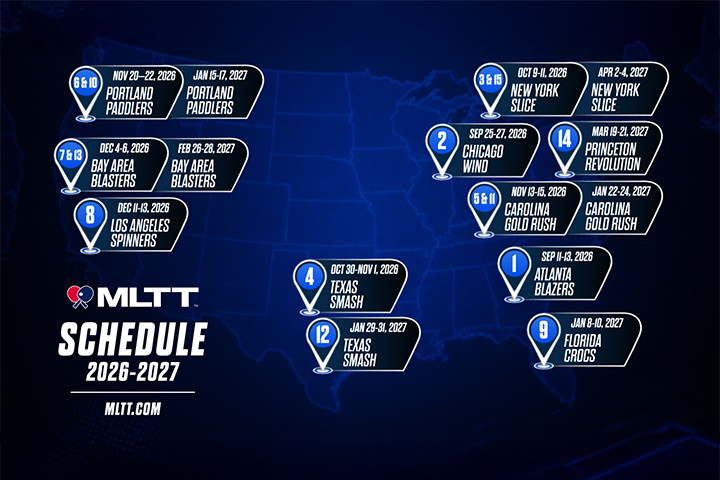
Ten teams will compete across twelve cities this season, from Atlanta's opener to stops in Chicago, New York, Texas, Carolina, Portland, the Bay Area, Los Angeles, Florida and Princeton.
Two franchises get two homes. Texas Smash hosts in Houston in October and Austin in January. New York Slice hosts in Westchester in October and the Bronx in April. Both teams will play in front of two different home crowds in the same season.
Three of those stops are new to the league. MLTT heads to the Miami-Dade County Fair and Expo in January, Palmer Events Center in Austin at the end of that month, and Fordham University's Rose Hill Gymnasium in the Bronx in April.
Home support has become a real advantage. Crowds sit close enough to hear the ball come off the paddle, and that energy shifts momentum in a way you feel most during a pressure-filled Golden Game.
International Stars Meet America's Rising Talent
MLTT's blend of international experience and emerging American talent remains its defining strength.
Twenty-one players on Season 4 rosters have competed at the Olympic Games, with 47 Games appearances between them. They line up alongside the next generation of American talent.
Every team has a name worth the ticket:
- Atlanta Blazers — Quadri Aruna (Nigeria), world No. 10, three-time Olympian
- Bay Area Blasters — Lily Zhang (USA), world No. 22, four-time Olympian
- Carolina Gold Rush — Eugene Wang (Canada), four-time Olympian, and Edward Ly at world No. 36
- Chicago Wind — Robert Gardos, the Hungarian-born Austrian ranked as high as world No. 18, alongside five-time Olympian Mo Zhang
- Florida Crocs — Omar Assar (Egypt), world No. 16, four-time Olympian
- LA Spinners — An Jaehyun (South Korea), world No. 13
- New York Slice — Koki Niwa (Japan), world No. 5 and the highest-ranked player in the league
- Portland Paddlers — Jens Lundqvist (Sweden), world No. 19, with Olympian Nikhil Kumar
- Princeton Revolution — Cho Seungmin (South Korea), world No. 30
- Texas Smash — Amy Wang (USA), world No. 39, Olympian
That mix of world-class veterans and rising young players gives MLTT a depth unmatched anywhere else in North American table tennis.
New Faces Mean New Storylines
The Season 4 Draft moved 24 players to new organizations, and the top of the board reshaped three rosters immediately: Aruna to Atlanta at No. 1, Omar Assar to Florida at No. 3, and An Jaehyun to Los Angeles at No. 5. Kang Dong-Soo went to Princeton at No. 7.
Veterans will wear new uniforms, young American players continue earning larger roles, and international stars will debut with new organizations.
Teams have also welcomed new coaches whose decisions may prove as consequential as any player's form. With Golden Games, Golden Points and open-serve doubles continuing to define the league, a coach's lineup call is often the difference.
Every season produces a breakout player. Season 4 will be no different, and nobody yet knows which name it will be.
Consistency Will Decide the Standings
Season 4 stretches from September through April, and talent alone will not carry a team through it.
The teams that rise will navigate injuries, international schedules, travel and the mental work of holding focus across seven months. Every weekend is a new challenge. Every point can move the standings.
By April, the teams combining talent, depth, chemistry and resilience will have earned their shot at the MLTT Cup.
The Road Starts Now
Every championship season begins with a single serve.
Over the next seven months there will be spectacular rallies, Golden Games that come down to a single point, comebacks nobody saw coming and new stars nobody had heard of in September. Some preseason favorites will meet expectations. Others will not.
What is certain is that the level of play has never been deeper, and starting this season it has never been easier to watch.
Season 4 opens September 11-13 in Atlanta. Tickets are on sale now at tickets.mltt.com, and every match streams live and free on the MLTT YouTube channel.
explore more news