POWER PAIRS: THE MLTT DUOS WHO WIN TOGETHER
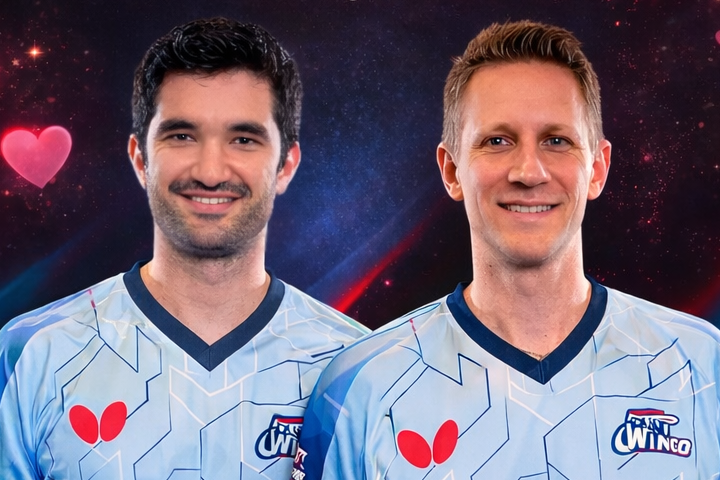
Valentine’s Day celebrates chemistry. In Major League Table Tennis, chemistry is not sentimental. It shows up in doubles stability, late-game trust, and the ability to win points when the entire building feels tense.
These are MLTT’s power pairs. Not romance. Partnership.
Each duo below combines styles, strengths, and competitive instincts in ways that directly change match outcomes. Some dominate with structure. Others disrupt with contrast. All of them give their teams belief when the score reaches 10-all.
IN MLTT, THE STRONGEST BONDS ARE FORGED UNDER PRESSURE.
This Valentine’s Day, meet the power pairs who win together.
PORTLAND PADDLERS
Jens Lundquist & Hampus Nordberg
Why they work
This is a system pairing. Both players commit to patterns, placement, and patience. Portland gains predictability in the best way. Opponents know what is coming and still struggle to stop it.
Pressure point
Extreme pace changes that try to break rhythm and force rushed finishes.
Valentine takeaway
Serve with intent. Play the pattern you choose. Make the opponent blink first.
CHICAGO WIND
Emmanuel Lebesson & Robert Gardos
Why they work
Experience and balance. When one is slightly off, the other still delivers. That reliability allows Chicago to manage doubles and Golden Game moments with confidence.
Pressure point
Fast exchanges into the middle to disrupt timing and rush the first attack.
Valentine takeaway
Win the first two contacts. Clean receiving unlocks Chicago’s entire lineup.
PRINCETON REVOLUTION
Koyo Kanamitsu & Seungmin Cho
Why they work
Anchor and accelerator. Cho brings steadiness and coverage across matchups. Kanamitsu supplies momentum when Princeton needs a spark.
Pressure point
Slow, spin-heavy rallies designed to bait forced finishes.
Valentine takeaway
Choose one identity per game. Take time away or out-spin. Do not mix plans mid-rally.
BAY AREA BLASTERS
Elsayed Lashin & Lily Zhang
Why they work
Different looks, same edge. Lashin disrupts rhythm. Zhang punishes hesitation. That contrast matters in MLTT’s rapid matchup environment.
Pressure point
Deep placement that removes the short game and forces straight-line power exchanges.
Valentine takeaway
Control first bounce early. When Bay Area owns the short game, they control the match.
TEXAS SMASH
Hiromitsu Kasahara & Joao Monteiro
Why they work
Two engines. One standard. Kasahara sets intensity and pressure. Monteiro brings scoring volume and adaptability.
Pressure point
Early doubles momentum. Losing it forces Texas into must-win singles late.
Valentine takeaway
Treat doubles as set one. Clean doubles unlock their best singles.
NEW YORK SLICE
Koki Niwa & Yiran Wu
Why they work
Creativity meets control. Niwa disrupts patterns. Wu stabilizes exchanges. Opponents rarely settle into one rhythm.
Pressure point
High-percentage play to wide corners that refuses to chase variation.
Valentine takeaway
Use creativity sparingly. Win two surprise points per game. Bank the rest.
CAROLINA GOLD RUSH
Enzo Angles & Chen Sun
Why they work
Grit and poise. Sun supplies steady singles value. Angles brings leadership and belief in big moments.
Pressure point
Early spin battles that force Carolina into passive positions.
Valentine takeaway
Attack first to the middle. Win crossover space before chasing the corners.
FLORIDA CROCS
Marc Duran & Asuka Sakai
Why they work
Pace and precision. Duran applies pressure. Sakai keeps points efficient and clean.
Pressure point
Loose serves that force Florida into extended defense.
Valentine takeaway
Win on ball five to seven. Florida thrives when points start to extend.
ATLANTA BLAZERS
Jiwei Xia & Yuya Oshima
Why they work
Fire and focus. Oshima delivers top-end production. Xia steadies early chaos and keeps Atlanta connected.
Pressure point
Early deficits that tempt Atlanta into pressing.
Valentine takeaway
No free points early. Tight serves and smart receives let talent win the long fight.
LOS ANGELES SPINNERS
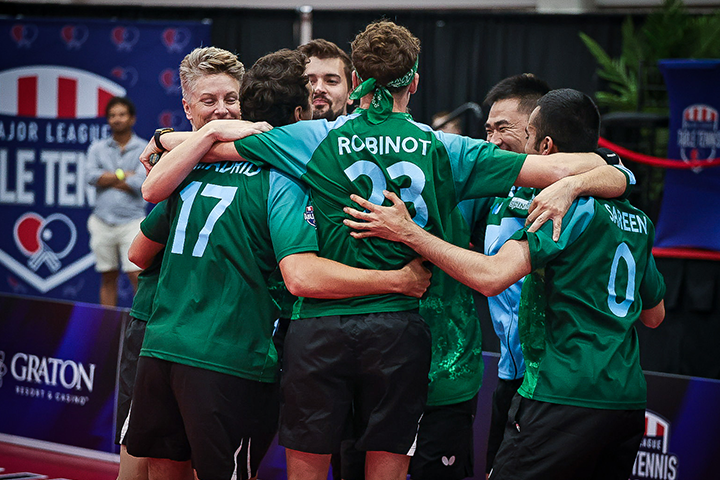
Matilda Ekholm & Alexandre Robinot
Why they work
Balance and belief. Robinot anchors matches. Ekholm adds touch, instincts, and fearless counterplay.
Pressure point
Extended topspin rallies designed to test patience.
Valentine takeaway
Win location first. Move opponents before going for pace.
FINAL THOUGHT
Valentine’s Day chemistry in MLTT is not about flash. It is about trust.
Portland wins with structure. Chicago with balance. Princeton with timing. Bay Area with contrast. Texas with pressure. New York with creativity. Carolina with belief. Florida with efficiency. Atlanta with energy. Los Angeles with balance.
Different paths. Same goal.
When the score hits 10-all, these are the partnerships that teams trust to finish the job.
No drama. Just points.
explore more news